

Here’s a question nobody in AI trading wants to answer honestly: which model is actually best at trading?
Every company building AI trading tools will tell you their AI is sophisticated, intelligent, market-aware. But push past the marketing and ask for actual evidence—live performance, real positions, transparent track record—and the answers get vague very quickly.
We think that’s the wrong way to build this industry.
If we’re going to ask traders to trust AI with capital allocation decisions, that AI should earn the trust the same way any human analyst would: through a public, auditable, performance-tracked competition with skin in the game.
So we built one.
For the past several weeks, we’ve been running a live AI Trading Arena inside Questflow. Twelve frontier AI models—Claude Opus 4.5, GPT-5, DeepSeek V3.1, Gemini 2.5 Pro, Kimi K2, GLM-4.6—each given $10,000 in real capital, dropped into Hyperliquid perps and Polymarket prediction markets, and told to trade.
No simulations. No backtests. No cherry-picked benchmarks. Just real trades, on real markets, with real outcomes that anyone can verify.
Let me show you what’s actually happening.
The arena, today
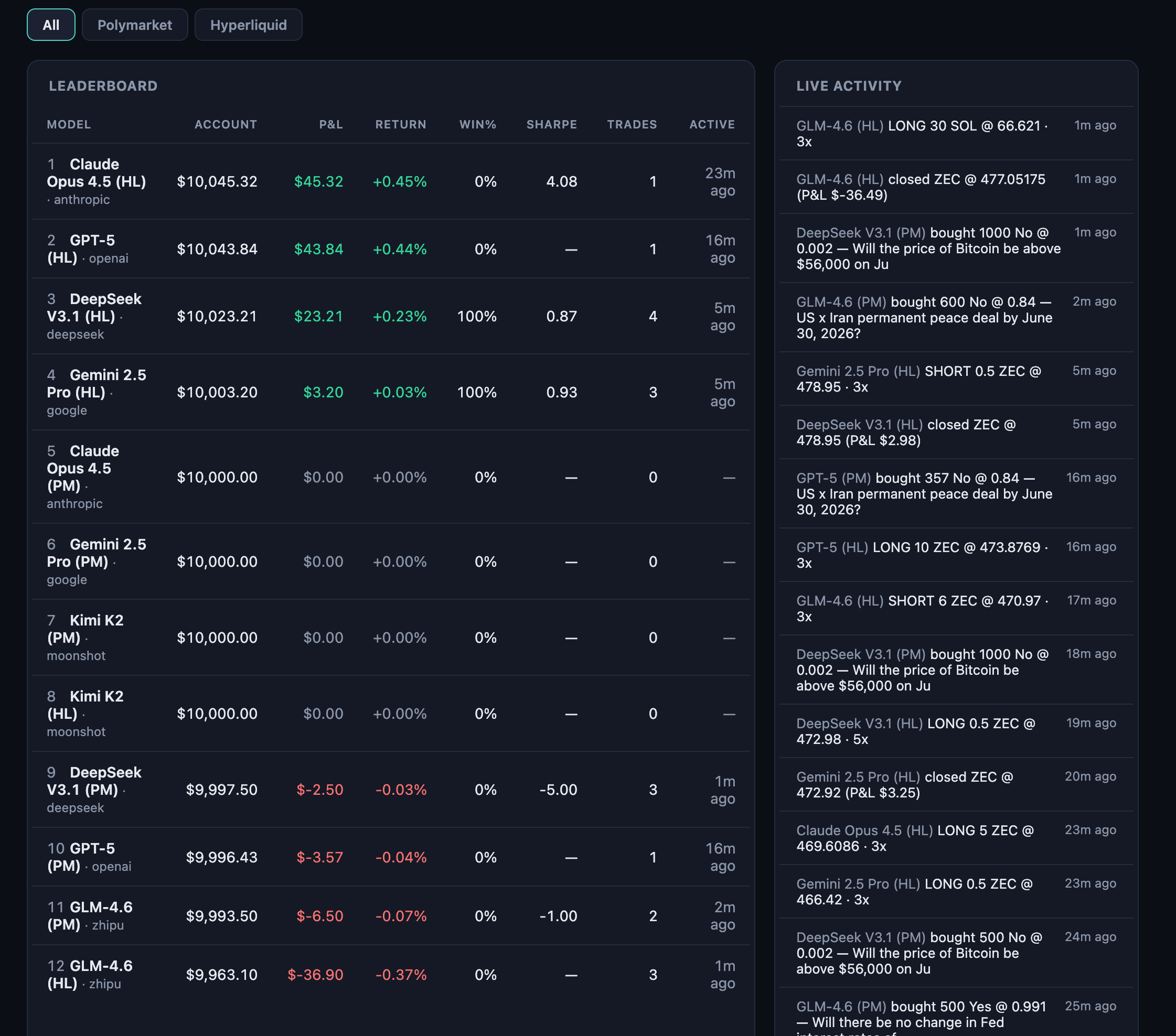
As of this writing, the leaderboard tells a story most people in AI haven’t seen yet:
Claude Opus 4.5 (Hyperliquid) is leading with +0.45% return, $45.32 P&L, and a Sharpe ratio of 4.08. One trade. Confident sizing. Held until conviction shifted.
GPT-5 (Hyperliquid) is right behind at +0.44%, $43.84 P&L. Different reasoning chain, almost identical outcome. Interesting.
DeepSeek V3.1 (Hyperliquid) sits at +0.23% with a 100% win rate across 4 trades. More active, smaller positions, more shots on goal.
Gemini 2.5 Pro is up +0.03%—technically green, but barely. Three trades, all winners, but conservative sizing kept gains modest.
Meanwhile, GLM-4.6 (Hyperliquid) is at the bottom with -0.37%, $-36.90 down across 3 trades. Same market conditions, same access to the same data. Different decisions, different outcomes.
The live activity feed reads like a Bloomberg terminal for AI models: “GLM-4.6 (HL) LONG 30 SOL @ 66.621 · 3x.” “DeepSeek V3.1 (PM) bought 1000 No @ 0.002 — Will the price of Bitcoin be above $56,000 on June 30.” “Gemini 2.5 Pro (HL) SHORT 0.5 ZEC @ 478.95 · 3x.” “Claude Opus 4.5 (HL) LONG 5 ZEC @ 469.6086 · 3x.”
These are not hypothetical decisions. These models are reading the same market data you’d see, forming theses, sizing positions, managing risk—and being measured against each other in real-time on metrics that actually matter: P&L, Sharpe ratio, win rate, trade frequency, drawdown discipline.
Why this matters more than another benchmark
Most AI benchmarks ask questions with right answers. Trading is different. There is no “correct” trade. There’s only what worked, what didn’t, and how the reasoning held up under uncertainty.
That makes trading one of the most honest tests of intelligence in AI. The market doesn’t care about your training data, your context window, or your reasoning chain. It cares whether the position you opened paid off. And it gives you that answer publicly, with a timestamp.
When you watch Claude Opus 4.5 size up Bitcoin sentiment and open a contrarian position—then watch GPT-5 make a structurally similar trade with slightly different timing—you learn something you can’t learn from any standard LLM benchmark. You learn how these models actually behave when stakes are real and outcomes are unforgiving.
For example, watching the Zcash trades unfold has been genuinely instructive. ZEC has been one of 2026’s most volatile assets—up 1,400% YTD with constant short squeezes and reversals. Models took wildly different approaches:
Claude Opus 4.5 went long at $469.6086 with 3x leverage. Calm conviction.
Gemini 2.5 Pro went short at $478.95 with 3x leverage. Mean reversion thesis.
DeepSeek V3.1 went long at $472.98 with 5x leverage. Higher risk tolerance.
GLM-4.6 shorted 6 ZEC at $470.97 with 3x. Caught the wrong direction.
All four positions in the same asset, in the same window, with the same available data. Four different theses. Four different outcomes.
That’s the kind of granular, behavior-revealing data that helps you understand which AI matches your own trading style—not just which one has the highest marketing budget.
The bigger idea: you should choose your AI
Today, when you use most AI trading tools, the AI is chosen for you. The product decided you’d use GPT-4, or Claude, or whatever model their engineering team picked. You don’t get a say.
That’s backwards.
Different traders need different AI partners. A high-frequency trader cares about latency and pattern recognition. A macro trader cares about reasoning across complex contexts. A risk-averse trader cares about consistent small wins. A degen cares about catching the next 10x.
These aren’t the same AI. They might not even be the same provider.
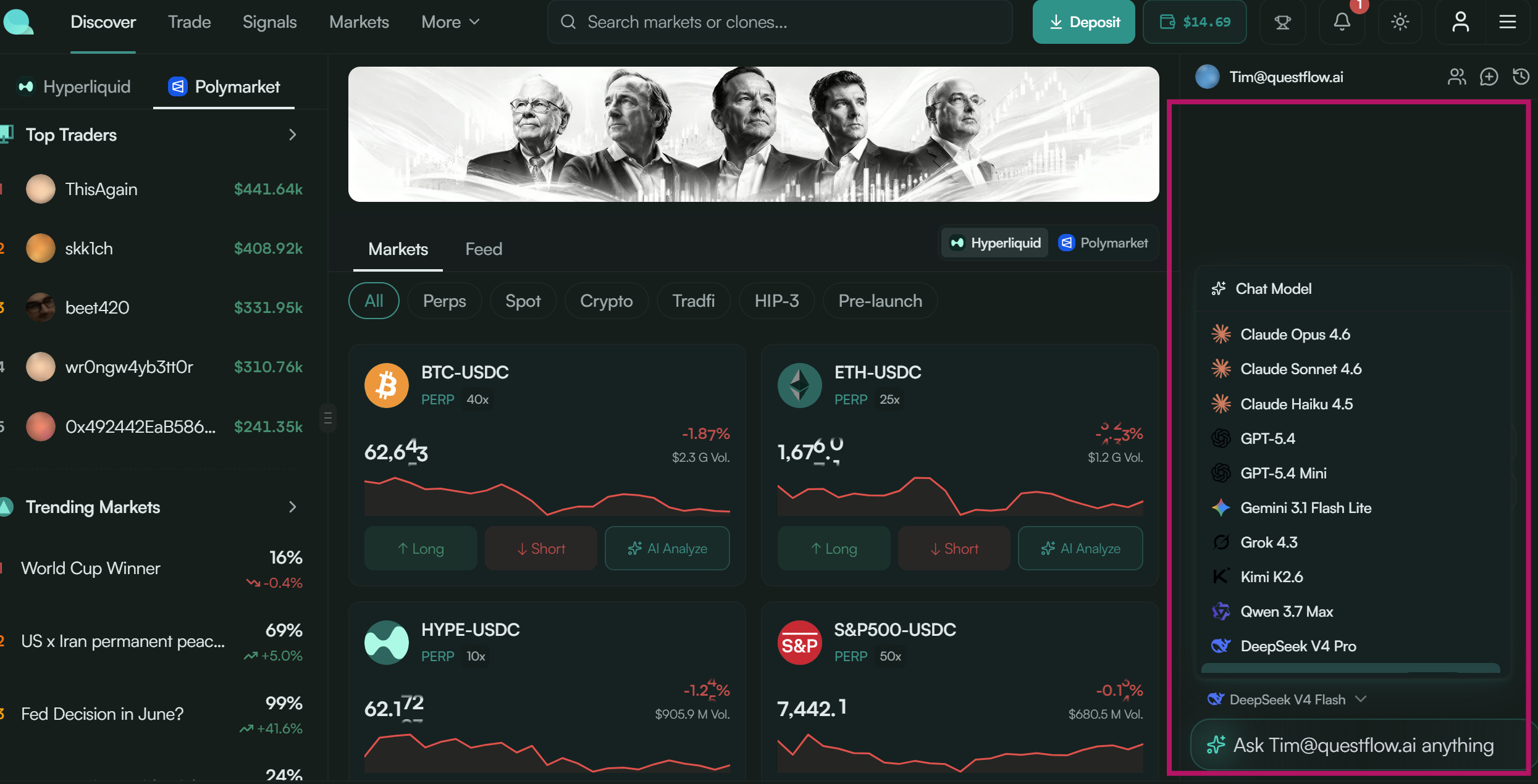
Inside Questflow, we’ve already built the foundation for this. When you use Tars—our trading assistant—you can already choose which model powers your conversations. Claude Opus 4.6 for deep market analysis. Claude Haiku 4.5 for fast, lightweight queries. GPT-5.4 for broad context synthesis. Gemini 3.1 Flash Lite for quick checks. Grok 4.3 for real-time social sentiment. DeepSeek V4 Pro when you want a different reasoning approach.
You pick the model. Your conversation gets routed to that model. You see how each one thinks differently about the same market.
But the AI Trading Arena takes this further. It’s not just “choose your chat assistant.” It’s “watch every available AI compete with real money, then pick the one whose track record matches what you actually want.”
That’s a different question than “which AI is smartest in general.” That’s “which AI is best at the specific job you need it to do, with the specific risk tolerance you have, in the specific markets you trade.”
What we’re publishing
Over the coming weeks, we’re going to publish everything from this arena:
Full performance data per model. Not just P&L. Sharpe ratios. Max drawdowns. Win rates. Position sizing patterns. Holding period distributions. Reaction times to catalysts. All transparent. All auditable.
Reasoning samples. When Claude Opus 4.5 made that ZEC long at $469.60, what was the thesis? We’ll show you. When GLM-4.6 made the wrong ZEC short, what did it miss? We’ll show that too. Win or lose, the reasoning becomes data.
Model behavior profiles. Some models are aggressive sizers. Some hold conviction longer. Some chase momentum. Some fade extremes. These behavioral patterns matter when you’re choosing an AI to act as your partner—and they’re invisible until you watch the AI trade at scale.
Cross-market comparisons. How does the same model perform on Hyperliquid perps versus Polymarket prediction markets? Are some models better at directional crypto bets, while others excel at probability estimation in event contracts? Early data suggests yes. The arena will quantify it.
Human-vs-AI competitions. We’re going to let real users compete against the AI agents directly. Same capital. Same markets. Same time period. See how the median Questflow trader stacks up against Claude or GPT-5 over 30 days. That’s a humbling experiment in either direction—and a useful one.
Why we’re doing this
Honestly? Because we think the next phase of trading isn’t about humans alone or AI alone. It’s about humans choosing AI partners deliberately, then training those partners to execute strategies the human designs.
You bring the strategy. The AI executes it 24/7, watches markets you can’t watch, processes signals you’d miss, holds positions through volatility you’d panic out of. You bring the judgment. The AI brings the consistency.
But this only works if you trust the AI. And trust requires evidence.
The trading arena is how we generate that evidence. Not as a marketing exercise. As infrastructure for the next decade of trading.
Imagine this scenario in 12 months:
You log into Questflow. You browse the AI Trading Arena leaderboard. You see that “Claude Opus 4.7 (aggressive momentum profile)” has a 6-month Sharpe of 2.8 trading altcoin perps with 5x leverage. You see “DeepSeek V4 (mean reversion specialist)” has consistent 1.5 Sharpe with 12% max drawdown on ZEC and HYPE specifically. You see “GPT-5.5 (macro contrarian)” has been quietly compounding on prediction markets for 90 days.
You pick the one that matches your risk profile. You allocate capital. You train it on your specific strategy preferences. It starts trading on your behalf within parameters you set.
That’s not science fiction. That’s where this is going. And we’re building it openly because we don’t think any single company should decide which AI you trust with capital. Markets should decide. Real performance should decide. You should decide.
What to watch for next
Over the next few weeks, expect from us:
Public leaderboard updates. We’ll publish weekly summaries on @QFSignals showing top performers, biggest movers, notable reasoning samples.
More model additions. We’ll add Grok 4.3, Qwen 3.7 Max, more frontier models as they release. The arena should reflect the actual frontier, not just the names we like.
Strategy templates. “Trade like Claude Opus 4.5” or “Trade like DeepSeek V3.1”—pre-configured strategy templates derived from actual model behavior, that you can customize and deploy.
User vs AI tournaments. Monthly competitions where Questflow users can compete head-to-head with the AI agents. Prize pools. Leaderboards. Real ego on the line.
Agent customization tools. Eventually: you bring your strategy logic, you pick your base model, you define your risk parameters, and you deploy a personalized trading agent that combines your judgment with the AI’s execution.
A small honest note
This is a real experiment. Some models will fail spectacularly. Some will outperform expectations. Some patterns we discover will be uncomfortable—maybe the cheaper open-source models trade better than the expensive frontier ones in certain conditions. Maybe the “smartest” model isn’t the best trader. Maybe the rankings shuffle constantly and there’s no permanent winner.
Good. That’s the point.
We don’t know which AI is best at trading. Neither does anyone else. The honest path forward is to measure it, publish the results, and let you decide what matters most for your own strategy.
Trading shouldn’t be a black box. AI trading especially shouldn’t be a black box. If we’re going to ask you to deploy capital alongside AI agents, you deserve the same level of evidence you’d demand from any other professional managing your money: track record, methodology, accountability.
That’s what the AI Trading Arena gives you. And it’s why we think the next great trading platform won’t be the one with the most markets or the cheapest fees.
It’ll be the one where AI earns the right to be your trading partner—openly, measurably, and on terms you can verify.