

MiniMax released M3.1 Flash on October 19. Shortly after the release, we ran the model through the latest version of Questflow’s financial benchmark.
The result was materially different from what we saw with the previous MiniMax generation.
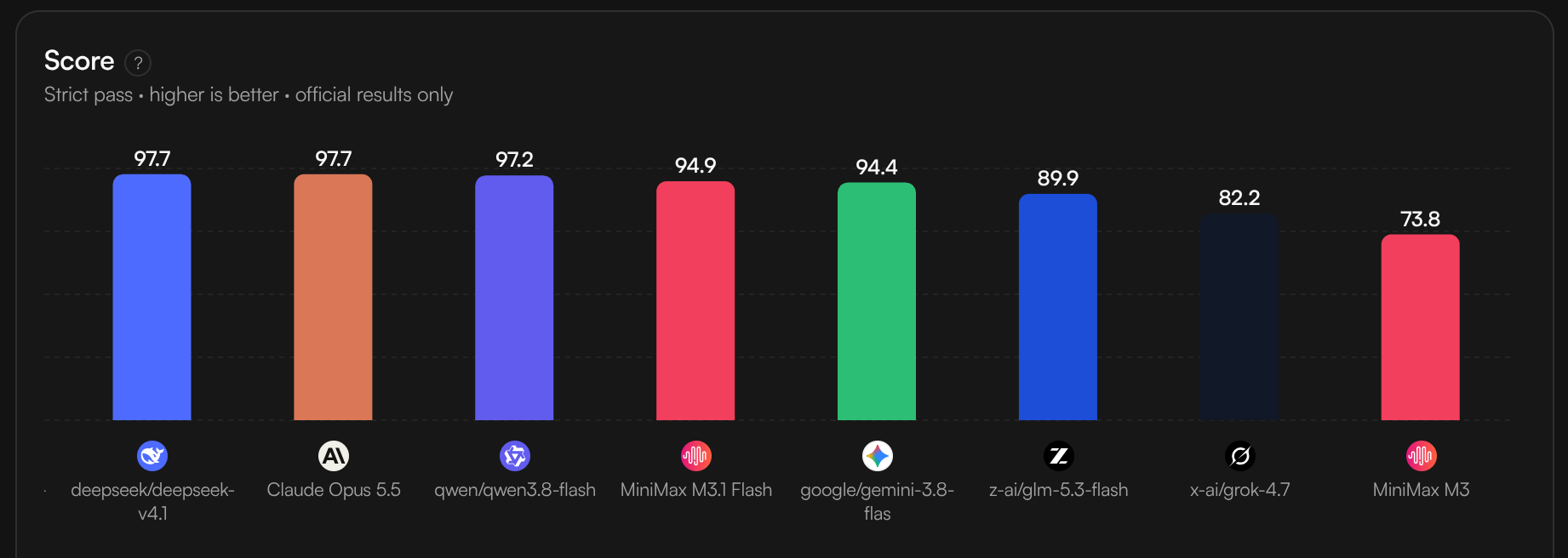
On our earlier benchmark run, MiniMax M3 remained clearly behind the strongest frontier models. In the new evaluation, M3.1 Flash improved by nearly 20 points and moved much closer to Claude Opus 5.5, one of the strongest models we have tested in financial workflows.
The significance of this result is not that MiniMax has suddenly become the “best financial model.” A single domain benchmark cannot support that conclusion, and broader evaluations still show meaningful differences between the two models. Artificial Analysis, for example, currently places Claude Opus 5.5 well ahead of M3.1 Flash on its aggregate Intelligence Index and on several general reasoning and terminal-based tasks. At the same time, M3.1 Flash performs competitively or better on selected agentic automation evaluations.
What is more interesting is the speed at which the gap changed.
For teams building financial Agents, this is becoming a recurring pattern. Capability that appeared concentrated among a small number of expensive frontier models can become widely available within one or two model generations. The practical frontier is therefore moving faster than conventional model rankings suggest, particularly in domains where performance depends on a combination of reasoning, structured data access, tool use, calculation and workflow execution.
Financial AI is entering a period in which capability gaps may compress much faster than product teams expect.
That changes both how models should be evaluated and how financial-agent systems should be designed.
Financial Performance Is Becoming More Domain-Specific
The AI industry still tends to discuss models as if intelligence could be represented by a single ordered list.
Claude is stronger than MiniMax. One GPT generation is stronger than another. A model that ranks higher on a broad benchmark is implicitly treated as the better choice for most applications.
That abstraction is useful at a high level, but it becomes increasingly inadequate once models are deployed inside specialized operational environments.
MiniMax M3.1 Flash illustrates the problem clearly.
Artificial Analysis gives Claude Opus 5.5 a substantial advantage on its aggregate Intelligence Index. Depending on the Opus configuration, Claude also remains significantly ahead on Terminal-Bench and several general reasoning evaluations. Yet on AutomationBench-AA, M3.1 Flash is highly competitive and in some configurations scores above Opus.
MiniMax’s own release materials report the same specialization pattern. The company highlights a score of 76.2 on BankerToolBench, which evaluates multi-step banking workflows involving document consistency, financial compliance and chained tool calls, alongside substantial gains in coding, computer use and other agentic tasks.
These differences matter because financial Agents do not operate on a generic intelligence leaderboard. They operate inside concrete workflows.
A financial Agent may need to retrieve historical financial statements, calculate derived metrics, screen thousands of securities, identify market events, rank candidates, interpret a chart, analyze wallet behavior, or execute a multi-step research process across several tools. Each of these tasks places different demands on the underlying model.
A model that is weaker in open-ended scientific reasoning can still be highly effective at structured financial screening. A model that is excellent at long-horizon coding may not be the most cost-effective choice for continuous market monitoring. Another model may perform particularly well when tasks require repetitive tool calls and structured transformations.
The relevant unit of comparison is therefore shifting from general model intelligence toward task-specific performance inside a defined financial environment.
For practitioners, the question is no longer simply:
Which model is strongest?
A more useful question is:
Which model performs this financial workflow most reliably, with these tools, at this latency and this cost?
That distinction will become increasingly important as Financial Agents mature.
A Financial Agent Is More Than Its Base Model
Financial benchmarking makes another limitation of general model comparisons particularly visible: the model itself is only one component of the system.
A production financial Agent typically operates inside an environment containing market data, fundamental data, financial definitions, code execution, search tools, specialized Skills, memory, portfolio state and permission controls.
The apparent intelligence of the Agent depends heavily on this environment.
Consider a simple example. Two models may both understand how to calculate a 20-day relative volume measure. One model retrieves the correct market history, excludes the current session from the baseline when required, calculates the ratio correctly and returns the appropriate securities. The second uses stale data or applies the wrong lookback definition.
The first system succeeds and the second fails, even though both models “know” the formula.
The difference is operational, not conceptual.
This becomes more pronounced as tasks grow more complex.
Suppose an investor asks an Agent to find U.S. equities that satisfy several conditions simultaneously: sufficient market capitalization and liquidity, volatility contraction over the previous month, price above the 50-day moving average, a breakout above a recent range on expanding volume, and no excessive move during the previous five sessions. The investor then wants the resulting securities ranked using a composite score.
The challenge is not simply understanding each indicator in isolation.
The Agent has to correctly define the universe, obtain the appropriate historical data, calculate multiple derived features, preserve the correct time ordering, apply all conditions consistently, evaluate the full universe rather than return a few plausible examples, and rank the surviving candidates correctly.
A strong language model can still fail because the surrounding data or tool architecture is weak.
Conversely, a smaller model can perform extremely well when the environment reduces ambiguity and provides reliable financial primitives.
This is one reason we increasingly view Financial AI as a systems problem rather than a pure model problem.
Why the Nearly 20-Point Improvement Matters
/home/timagent/Pictures/screenshot-2026-10-21_10-05-00.png
A large generational jump is useful because it reveals where the bottleneck may have moved.
When MiniMax M3 scored materially below leading models, one interpretation was straightforward: the underlying model capability was not yet sufficient for some classes of financial work.
When the next generation closes much of that gap, the limiting factor changes.
The bottleneck may become task design, tool quality, data quality, model routing or domain-specific evaluation.
This pattern is consistent with what we have observed more broadly in our benchmark work.
Earlier this year, several categories of financial tasks produced substantial separation among models. Scores in the 60s or 70s were not unusual. The same kinds of tasks are now increasingly solved with scores in the 90s by stronger models.
This does not mean financial AI is solved.
It means some parts of the benchmark are becoming saturated.
That distinction is critical.
A benchmark is valuable only if it continues to measure unresolved capability. Once most frontier models can perform a task reliably, the task still has value as a baseline competency test, but it contributes less information about the frontier.
The correct response is not simply to add more examples of the same task.
If every strong model can calculate revenue growth correctly, creating another 1,000 revenue-growth questions does not produce a better frontier benchmark.
The evaluation has to move toward deeper combinations of financial capabilities.
The Benchmark Must Evolve With the Models
This creates a structural problem for financial benchmarking: the question bank cannot be treated as a static asset.
Traditional benchmarks are often constructed once and then used for years. That works reasonably well when the underlying capability evolves slowly.
Foundation models are improving too quickly for that assumption.
A financial benchmark built around tasks that were challenging six months ago may become substantially less discriminative today. If the benchmark remains unchanged, scores converge toward the top and the leaderboard gradually measures historical difficulty rather than current capability.
Our experience suggests that the solution is not arbitrary difficulty inflation.
A benchmark should not become harder by hiding facts in more documents, introducing obscure terminology or adding unnecessary reasoning steps. That approach may reduce model scores without making the evaluation more relevant.
The better source of difficulty is real financial work.
Real users naturally generate difficult problems because financial decisions are compositional.
They do not usually ask for one isolated indicator. They describe an investment process.
A trader might ask an Agent to identify assets that satisfy a liquidity requirement, a particular volatility regime, a momentum condition and a breakout rule, while excluding securities that have already moved too far. A crypto investor might combine market structure, token liquidity, wallet behavior and capital flows. A portfolio manager may require a system to interpret several signals differently depending on the prevailing market regime.
These questions are difficult because multiple pieces of financial logic have to remain correct simultaneously.
That is precisely the type of difficulty a financial benchmark should preserve.
From Financial Questions to Financial Algorithms
As user requirements become more sophisticated, the boundary between a natural-language request and an algorithm begins to disappear.
Many serious financial prompts are effectively programs written in financial language.
An investor might define a process such as:
Start with all sufficiently liquid securities. Measure short- and medium-term volatility. Identify names experiencing volatility contraction. Require the price to remain above a trend measure. Detect a breakout from a recent range. Exclude securities with excessive recent appreciation. Rank the remaining candidates using a weighted combination of volume expansion, breakout strength and volatility compression.
Each individual operation is relatively simple.
The difficulty is in execution fidelity.
The model has to translate the investor’s intent into a deterministic process without silently changing definitions. It needs to understand which periods to use, whether the current bar is included, which price adjustments apply, how missing data should be treated and how ranking should be calculated.
For trading-oriented Financial Agents, this capability matters far more than the ability to generate a polished market narrative.
A model can write an excellent explanation of momentum trading and still fail to identify the correct momentum candidates.
The latter failure is what matters in production.
This is why our benchmark direction increasingly emphasizes workflows such as retrieval, calculation, market screening, signal detection, ranking and expert pattern recognition rather than financial knowledge alone.
The core question is whether a model can turn financial intent into a correct work product.
Cost Changes the Meaning of “Best”
The MiniMax result becomes more consequential when capability is considered alongside cost.
MiniMax prices M3.1 Flash at $0.15 per million input tokens and $0.60 per million output tokens. The company also states that agentic-task usage costs are approximately 70% lower than the previous generation.
Artificial Analysis lists Claude Opus 5.5 at $4 per million input tokens and $20 per million output tokens. On its standardized task-cost estimates, the gap between the two models remains substantial, although actual production cost will depend on reasoning settings, token usage, caching and tool behavior.
This cost difference matters much more in Financial Agents than in occasional chatbot usage.
A financial research application might invoke a model once to produce an investment memo. In that context, several dollars of additional inference cost may be irrelevant.
A market-monitoring Agent operates under very different economics.
It may evaluate hundreds or thousands of securities repeatedly. It may run continuously across several markets. It may perform multiple screening passes before escalating only a small subset of cases for deeper analysis.
If a lower-cost model can perform the first 90% of that workflow with comparable reliability, routing every task to the most expensive frontier model becomes economically inefficient.
The practical optimization target therefore changes.
It is not maximum benchmark score in isolation.
It is some combination of accuracy, false-positive rate, false-negative rate, latency and cost.
For many Agent architectures, this will lead naturally to model routing.
A fast and inexpensive model can monitor large universes and perform routine screening. A more expensive reasoning model can be invoked when a task becomes ambiguous, when conflicting evidence appears or when a high-value decision requires deeper analysis.
The architecture starts to resemble a research organization more than a chatbot.
Not every task needs the most senior analyst.
Model Routing May Matter More Than Model Loyalty
This leads to an important engineering implication.
Financial-agent products should probably avoid becoming structurally dependent on one model provider.
Model leadership is becoming too temporary.
A workflow that requires Claude today may be viable on MiniMax tomorrow. A new Gemini, GPT, DeepSeek or Kimi release may change the trade-off again several weeks later.
The system therefore benefits from separating the financial environment from the model.
Data access should remain consistent.
Tool schemas should remain stable.
Financial metric definitions should remain versioned.
Evaluation should be reproducible.
The underlying model can then be replaced or routed according to measured performance.
This is also why benchmarking has practical value beyond publishing a leaderboard.
A benchmark becomes part of model infrastructure.
When a new model is released, it can be inserted into the same financial environment and evaluated against the same classes of work. Teams can then answer concrete questions: Is it reliable enough for screening? Does it miss more qualifying assets? Is ranking quality better? Does the cost advantage justify a small accuracy trade-off? Which task families should be routed to it?
That is much more useful than knowing that a model gained several points on a general intelligence index.
The Durable Advantage Moves Outside the Model
As model capability becomes more abundant, the source of durable differentiation changes.
Access to a strong foundation model is no longer rare. Most teams can call the same APIs.
What remains difficult to reproduce is the domain system surrounding the model.
In finance, that includes reliable historical and real-time data, canonical metric definitions, high-quality tools, specialized Skills, portfolio context, persistent memory, deterministic evaluation, execution infrastructure and risk controls.
It also includes something even more important: financial judgment.
A model may become extremely good at following a sophisticated trading framework. That does not mean the model created the framework.
This distinction matters for how we think about Financial Agents at Questflow.
We do not assume that the primary source of differentiated investment judgment should be a generic model generating strategies from scratch. Professional investors and portfolio managers already possess differentiated ways of interpreting markets. They decide which signals matter, how signals interact, what invalidates a thesis, how risk should be sized and when a technically valid setup should still be ignored.
AI can make that judgment more scalable.
It can convert parts of an investor’s process into structured rules and monitoring tasks. It can watch the market continuously, identify conditions that match the framework, explain what changed and eventually execute within explicit permissions.
As foundation models become cheaper and more capable, the economics of scaling this judgment improve dramatically.
This may be one of the most important consequences of capability compression.
The value is not simply that existing AI products become cheaper.
Entire categories of persistent financial analysis become economically feasible.
Financial Intelligence Is Moving From Knowledge to Execution Fidelity
The progression of financial AI can be viewed in several stages.
The first stage emphasized knowledge: does the model understand financial concepts?
The second emphasized analysis: can it retrieve information, calculate metrics and reason over financial documents?
The current stage increasingly emphasizes operational fidelity: can it correctly apply a financial process over real data?
This is where the benchmark becomes much closer to the requirements of trading systems.
For a trading-oriented Agent, a plausible answer is insufficient.
The result must be correct enough to act on.
If the task is to find 20 qualifying assets and the model returns 17, the three missing assets are false negatives.
If it returns five securities that do not satisfy the conditions, those are false positives.
If it identifies the correct set but ranks them incorrectly, that is a ranking error.
These failures can be measured directly.
This is why Financial Agent evaluation should increasingly resemble a combination of information retrieval, quantitative testing and workflow validation rather than traditional language-model judging.
The closer AI gets to capital allocation, the less useful “looks reasonable” becomes as an evaluation standard.
What the MiniMax Result Actually Tells Us
The most important conclusion from our latest run is therefore not that MiniMax M3.1 Flash has overtaken one particular model.
It has not demonstrated that universally, and broader benchmarks continue to show clear areas where Claude Opus 5.5 is stronger.
The result tells us something more useful.
The gap between a relatively inexpensive model and a top-tier frontier model can shrink dramatically within one generation for a specific class of financial tasks.
That has three implications.
First, financial capability is becoming increasingly domain-specific. General model rankings are useful but insufficient for production model selection.
Second, the economics of Financial Agents are changing as quickly as their capabilities. When performance converges while inference costs remain far apart, architecture and routing become strategic decisions.
Third, financial benchmarks must evolve continuously. A task set that successfully discriminates models today may become saturated within months.
For us, this reinforces a simple principle: the benchmark cannot be the dataset.
The benchmark must be a living evaluation system connected to real financial work.
Its role is to continuously translate user requirements, market workflows and expert investment processes into reproducible tests of model capability.
As models master one class of task, the evaluation has to move toward the next unresolved layer.
That is how a benchmark remains useful in a field moving this quickly.
The Frontier Is Moving From Models to Systems
The broader direction is becoming clearer.
Foundation-model capability will continue to improve. Price-performance ratios will continue to fall. Individual model leadership will continue to change.
That makes it increasingly difficult to build a durable financial product around the proposition that it uses one particular model.
The more defensible layer is the financial system built around interchangeable models.
A system with high-quality data, reliable tools, strong evaluation, sophisticated routing and structured sources of investment judgment can benefit every time a new model improves.
Instead of being disrupted by model turnover, it absorbs it.
MiniMax M3.1 Flash is a useful example.
A nearly 20-point generational improvement changes the economics of where that model can be deployed. Tasks that may have required a more expensive model can potentially move to a lower-cost layer. Continuous screening can become cheaper. More assets can be monitored. More financial workflows can run in parallel.
The next model release may change the architecture again.
That should be expected.
For Financial AI, the durable competitive advantage will increasingly come from designing systems that assume intelligence itself will continue to become cheaper and more available.
The model remains important.
But the model is becoming one component in a much larger financial stack.
And as the capability gap compresses, the real differentiation shifts toward the quality of the data, the financial workflows, the evaluation framework, the risk architecture and, ultimately, the judgment that the Agent is designed to operationalize.