

Sometime around June 1, 2026, while most of crypto was still arguing about memecoins and L2 narratives, something genuinely historic happened: Binance—the world’s largest crypto exchange—quietly opened trading on 7,000+ US stocks and ETFs for its non-US users. Zero commissions. Fractional shares starting at $5. Funded with stablecoins.
The press release was characteristically measured. “A major step in Binance’s vision to build a multi-asset financial super app.” But strip away the corporate language and what just happened is remarkable: the largest crypto exchange on earth just became a stockbroker.
And it’s not alone. The same week, Hyperliquid’s HYPE hit an all-time high of $75.51, pushing its market cap past $15 billion and into the global top 10—flipping Dogecoin in the process. The catalyst wasn’t crypto speculation. It was the fact that 47% of Hyperliquid’s trading volume now comes from tokenized real-world assets—stocks, commodities, pre-IPO equity. Tokenized gold alone hit $90.7 billion in Q1 2026 spot volume, surpassing all of 2025.
Meanwhile, the SEC published an innovation exemption for tokenized stocks. Daily tokenized stock volume crossed $3.57 billion on May 19. Citi projects the sector reaches $2.6 trillion by 2030.
Pause for a second. We’re watching crypto rails absorb traditional finance in real time—and the speed is accelerating, not slowing down.
Here’s the part nobody’s talking about yet: when every major exchange offers tokenized stocks, when compliance is no longer the bottleneck, when the rails are commoditized—what’s left to compete on?
That’s the question Questflow has been quietly building an answer for.
The convergence that’s no longer a thesis
For two years, “RWA tokenization” was a slide in every crypto deck and a sentence in every research report. The thesis: trillions of dollars of traditional assets would move on-chain. The objection: regulators wouldn’t allow it.
In May and June 2026, those objections collapsed.
Let me show you what actually happened, condensed:
Let me show you what actually happened. Here’s the timeline of just the last 90 days:
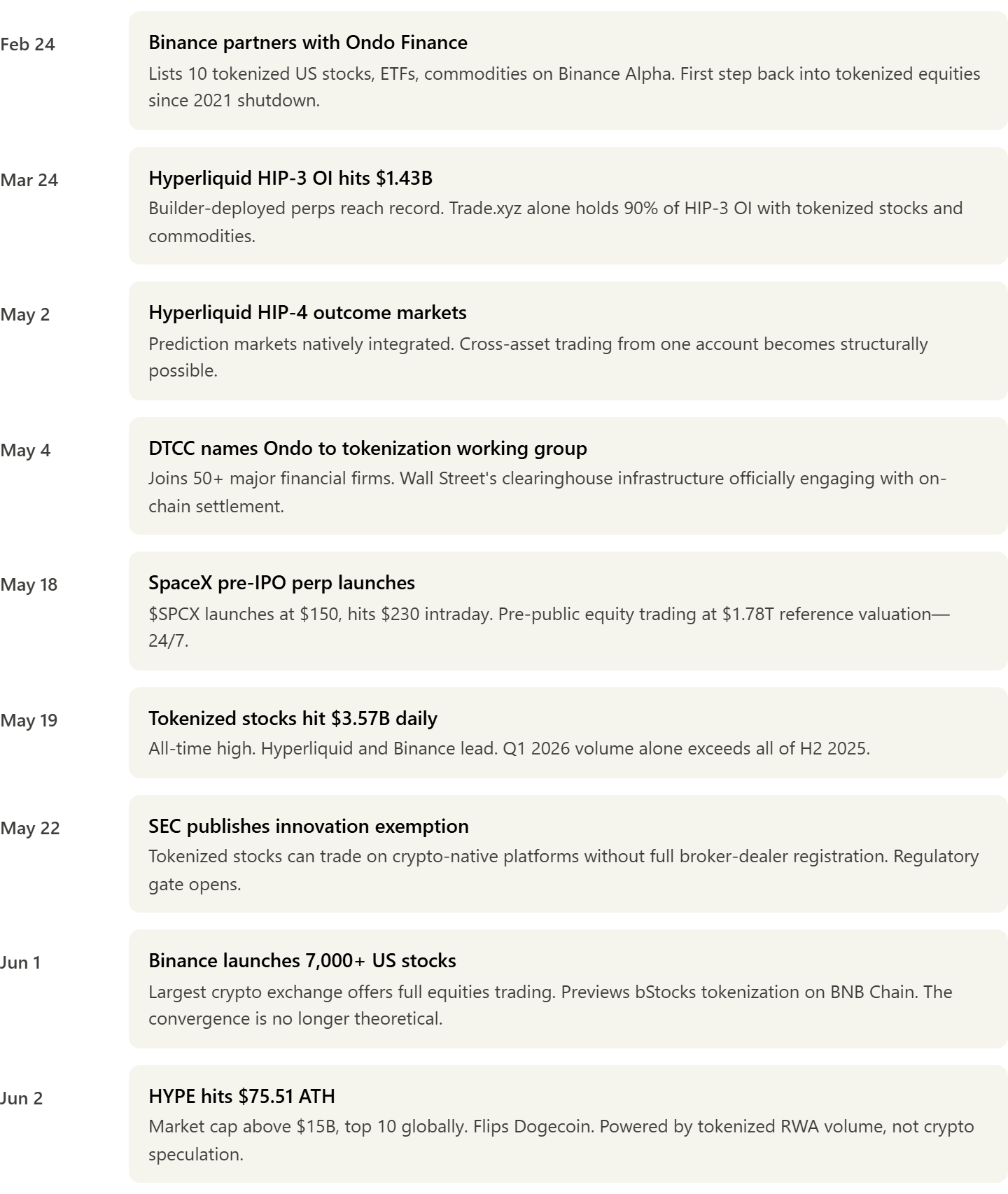
Look at that timeline. Each event in isolation feels like “another crypto news cycle.” Strung together, they describe a regime change.
For a decade, crypto and traditional finance treated each other as rival systems. Crypto was the rebel infrastructure that bypassed Wall Street. Wall Street was the establishment that gatekept access. They competed for the same users with fundamentally incompatible value propositions.
That story is over. Wall Street is not being disrupted by crypto. Wall Street is migrating to crypto rails.
Binance using ADGM-licensed broker-dealers with Alpaca clearing. Hyperliquid’s HIP-3 oracle infrastructure pulling from CME-grade data feeds. Ondo holding real shares at Alpaca while issuing chainlink-fed synthetic equity tokens. The DTCC—the entity that clears nearly every traditional securities trade in the US—publicly committing to tokenized production trades by July.
The infrastructure isn’t being replaced. It’s being re-implemented on faster, more programmable rails. And the regulators are finally signing the building permits.
What this looks like, in numbers
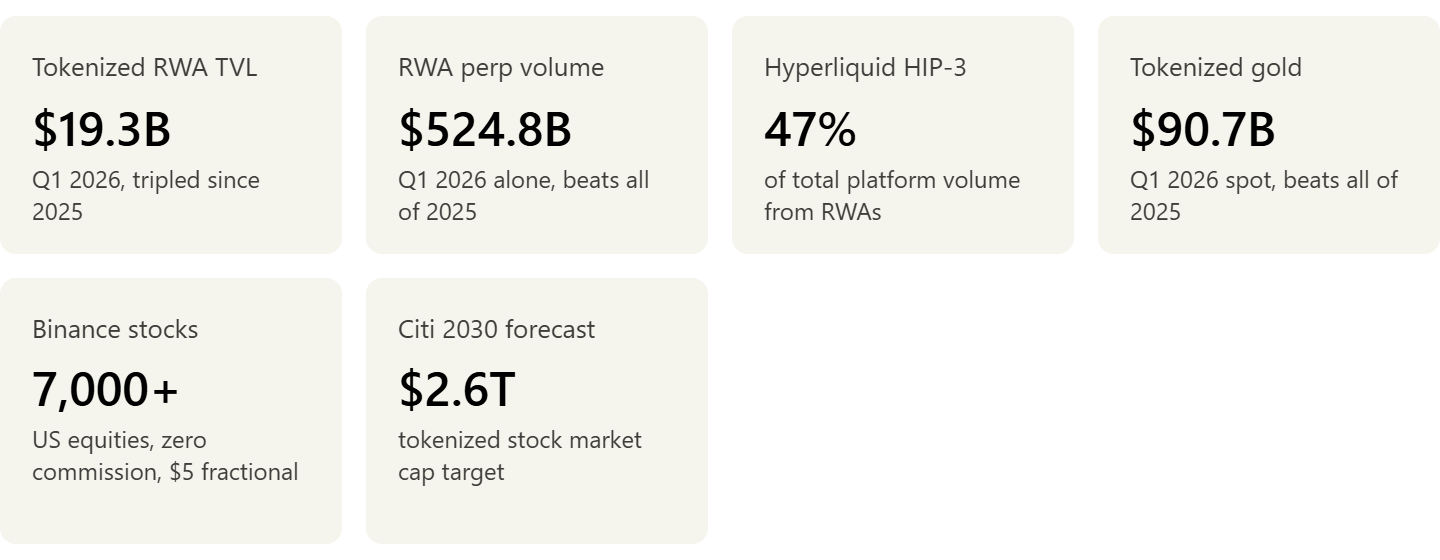
These aren’t speculation numbers. These are settled transactions, executed and cleared. Tokenized gold is being traded at scale. Tokenized stocks are doing $3.5B daily. Hyperliquid’s volume is now half non-crypto.
For perspective: at $1.4 billion in tokenized stock market cap today, the sector is roughly 0.001% of the $134 trillion global stock market. That’s the exact starting point stablecoins occupied in 2020, before they grew into a $300 billion category in four years.
If tokenized stocks follow the stablecoin trajectory, we’re looking at the largest single redistribution of trading volume in the history of financial markets.
So what does Questflow actually do here?
Here’s where I want to be honest with you.
Questflow is not going to compete with Binance on equity listings. Binance has broker-dealer licenses, $400B+ in custody, and 250 million users. We’d be insane to try.
Questflow is not going to compete with Hyperliquid on perpetual liquidity. Hyperliquid built a custom L1 for sub-second order book execution. They’re processing $170B+ monthly volume. That’s their game.
What we’re building is different. And the timing matters.
When platforms commoditize access—when literally every major exchange offers tokenized stocks, perps, predictions, and spot crypto—the question for traders shifts.
It’s no longer “where can I trade TSLA?” It’s “given that I can trade TSLA on Binance, Hyperliquid, Ondo Global Markets, and three other places, how do I know what to do with that access?”
That’s an intelligence problem. And it’s the problem we’re spending all our engineering effort on.
The thing nobody else is building
Watch what happens when financial infrastructure converges but human cognition doesn’t:
A trader in Singapore on June 1 has access to 7,000 US stocks via Binance, 250+ tokenized equity perps via Hyperliquid, all of Polymarket’s prediction markets, ZEC on Robinhood, ONDO and HYPE on every CEX, and pre-IPO SpaceX perps with 24/7 pricing.
She has more market access than a Goldman Sachs trader had in 2015.
But she’s still one person. With one screen. With the same 24 hours in her day.
When the Fed signals a rate cut, she should be checking how that catalyst affects: equity prediction markets on Polymarket, BTC perp positioning on Hyperliquid, gold tokenized commodity exposure, rate-sensitive US equity sectors, USDC funding rate dynamics across DEXs.
She’ll catch maybe two of those. The other three move without her.
This is the gap. And it’s getting worse as access expands, not better.
Questflow’s bet: the next decade of trading isn’t about who has more markets. It’s about who has the AI infrastructure to make sense of having more markets.
Specifically:
AI Clones that watch everything you can’t. A personalized AI agent that monitors your asset universe continuously—not just price action, but catalysts, correlations, on-chain flows, sentiment shifts. It doesn’t replace your judgment. It surfaces what your judgment should be operating on.
Cross-market intelligence. When SpaceX pre-IPO perps launched on May 18, the obvious trade was $SPCX. The non-obvious trades were $HYPE (the platform benefiting), Tesla (ecosystem play), and Starlink-adjacent stocks. Your Clone should connect these in real-time, not in next week’s research report.
Signal-driven feeds, not data feeds. The @QFSignals account on X has been running a live experiment in what this looks like. Every signal opens with “Your AI Clone just spotted what the market’s sleeping on”—then specific price action, catalyst context, technical setup. Not noise. Synthesis.
Native integration of HIP-3 stock perps. We integrated Hyperliquid’s HIP-3 specifically because it solves what Ondo’s tokenized stocks can’t: 24/7 price discovery on US equities. Want to react to weekend Tesla news? Ondo’s locked until Sunday 8 PM ET. HIP-3 trades through it. We give you both, and your Clone tells you which one fits your trade.
Agent trading infrastructure. Coming. The natural conclusion of AI-augmented trading is: at some point, your Clone executes within parameters you set. Not autonomous yet—that’s a different problem. But “execute this strategy when these conditions converge”—that’s a tool we’re building.
What this article doesn’t argue
I’m not going to tell you Questflow is bigger than Binance. We’re not. We’re not going to be.
I’m not going to tell you we have more liquidity than Hyperliquid. We don’t. We don’t need to—we route to them.
I’m not going to argue the next bull run will be won by a single product feature. It won’t. Markets are too complex now for that thesis to be honest.
What I will tell you is this: the era when “access to markets” was the competitive moat is ending. Binance just proved it by handing access to 7,000 stocks to anyone with a stablecoin. Hyperliquid is proving it by letting any builder deploy permissionless perp markets via HIP-3. The SEC is proving it by writing exemptions that let crypto-native platforms list equities.
When access commoditizes, the new moat becomes intelligence.
Not “AI” as marketing copy. Actual infrastructure that helps a trader in Singapore process the same information flow as a Goldman trader, find the trades human cognition would miss, and execute across the now-converged stack of crypto + equities + commodities + predictions.
That’s what we mean when we say “AI-native trading platform.” And that’s why the convergence everyone’s celebrating is, paradoxically, why platforms like us exist.
What to watch next
A few honest predictions for the next 12 months:
Most CEXs will offer tokenized stocks by year-end. Following Binance, expect Coinbase, OKX, Bybit. The competitive pressure is too high.
HIP-3 markets will multiply. Pre-IPO Stripe, OpenAI, Anthropic perps. Sector-specific baskets. International equities. With 500K HYPE stake required per market deployment, the supply curve on HYPE compresses as RWA expands.
Hyperliquid’s RWA percentage will keep climbing. Matt Hougan predicts 70% by year-end. The structural reason: crypto-native users now have access to every asset class without leaving on-chain infrastructure.
The intelligence layer becomes the conversation. Once everyone has the same markets, the question becomes “whose AI is helping you trade them?” That’s where Questflow lives.
Regulatory clarity expands beyond US. The SEC innovation exemption is one node. EU’s MiCA framework, ADGM’s licensing infrastructure, Singapore’s MAS rules—all converging on tokenized securities as legitimate.
A small note for the long-time crypto readers
If you’ve been in this space since 2017, this moment probably feels weird. The thing we always said would happen—real-world assets on-chain, traditional finance migrating to programmable rails—is actually happening. And it’s happening through a partnership between crypto-native infrastructure (Hyperliquid, Ondo) and traditional brokerage (Alpaca, ADGM), not through one side conquering the other.
That’s not the “crypto wins” narrative we were sold. It’s better than that. It’s “everyone gets faster, cheaper, more programmable infrastructure.” And it’s why HYPE traded like a fintech stock this year instead of a crypto token.
The work ahead—the work Questflow is doing—is making that infrastructure actually usable by humans who don’t have 14 monitors and a team of analysts. Making it intelligent. Making it personal. Making it feel less like “you have access to everything” and more like “you have a partner who actually helps you act on it.”
That’s a different game than the platform race. And it’s the one we think matters most.
Try AI-native trading at next.questflow.ai