

We’re living in the golden age of AI. Every week brings new models, new capabilities, new possibilities. Tools like Manus, Genspark, Base44, and Perplexity are pushing boundaries. Image generation platforms are creating stunning visuals. Workflow automation tools are connecting our digital lives.
Yet despite all this innovation, creating with AI remains frustratingly complicated for most people.
The problem isn’t the technology itself. The problem is the gap between what AI can do and how easily people can actually use it. At Questflow, we’ve been thinking deeply about this gap, and we believe we’ve found a better way forward.
The Prompt Engineering Tax Everyone Pays
Here’s what actually happens when you try to create something with AI today.
You have an idea. Maybe you want to generate a marketing campaign. Or build an automated workflow. Or create a series of images with a consistent style. Simple enough, right? Wrong.
First, you need to write the perfect prompt. Not just any prompt, but one that’s detailed enough to capture your vision, structured enough to get consistent results, and refined enough to avoid common pitfalls. You spend twenty minutes crafting it. The result is close but not quite right.
So you iterate. You add more context. You specify the style differently. You clarify the constraints. Another fifteen minutes. Better, but still not there.
By the time you’ve gotten something usable, you’ve spent an hour on what should have been a three-minute task. And that’s assuming you’re already familiar with prompt engineering techniques. If you’re new to this, multiply that time by three.
This is the prompt engineering tax, and everyone pays it. Even experienced AI users spend significant time crafting and refining prompts for complex tasks.
The Expert-Only Problem
Look at any AI community and you’ll see the same pattern. The people getting great results are the ones who’ve invested serious time learning the craft. They know which models work best for what. They understand token limits and context windows. They’ve built libraries of proven prompts.
These power users create incredible things. But they represent maybe five percent of people who try AI tools.
The other 90% struggle. They get inconsistent results. They can’t figure out why something worked yesterday but not today. They eventually give up and go back to doing things manually.
This isn’t a user problem. This is a design problem.
When your product requires users to become experts before they can be productive, you haven’t built a tool. You’ve built a puzzle. And most people don’t have time for puzzles when they have real work to do.
The Fragmentation Mess
Even if you master the prompting, there’s another problem. The AI landscape is incredibly fragmented.
Want to generate images? That’s one tool, probably with its own subscription. Need to build a workflow? Different tool, different subscription. Want to analyze data? Another platform. Trying to create video content? Yet another service.
Each tool has its own interface, its own learning curve, its own pricing model. You’re constantly context-switching, copying and pasting between platforms, maintaining multiple subscriptions that add up to hundreds of dollars per month.
Manus excels at certain tasks. Genspark at others. Perplexity for research. Each image generation tool has different strengths. You end up with a dozen tabs open, multiple accounts to manage, and a mental map of which tool to use when.
This fragmentation creates friction at every step. The more friction you have, the less you create. And the less you create, the less value you get from all those subscriptions.
What If AI Creation Worked Like Netflix?
Think about how you use Netflix. You don’t need to understand video codecs or streaming protocols. You don’t need to configure anything. You just browse, pick what you want, and watch.
What if AI creation worked the same way?
You open the platform. You see what’s trending. You browse by category. You find something that’s close to what you need. You use it, or you customize it slightly. Done.
No prompt engineering. No tool configuration. No expert knowledge required.
This is what we’ve built at Questflow.
Discovery First, Creation Second
When you open Questflow, you don’t see a blank prompt box demanding expertise. You see a rich library of what’s already working.
Trending creations that people are actually using. Productivity workflows organized by category. Investment trackers monitoring real-time data. AI utilities solving common problems. Finance automation handling repetitive tasks. Life management tools keeping people organized. Education resources accelerating learning.
Someone has already built a social media campaign generator that works. Another person created a data analysis workflow that’s proven. A third creator made an image generation setup with consistent style.
You don’t start from scratch. You discover what exists. You see what’s working for others with similar needs. You find something that’s 80% of what you want.
Then you make it yours.
Remix, Don’t Rewrite
Here’s the key insight: most people don’t need to create something entirely new. They need to adapt something that already works.
Musicians don’t reinvent music theory for every song. They sample, remix, and build on what came before. Designers don’t start from blank canvas every time. They use templates and customize. Developers don’t write everything from scratch. They fork repositories and modify.
AI creation should work the same way.
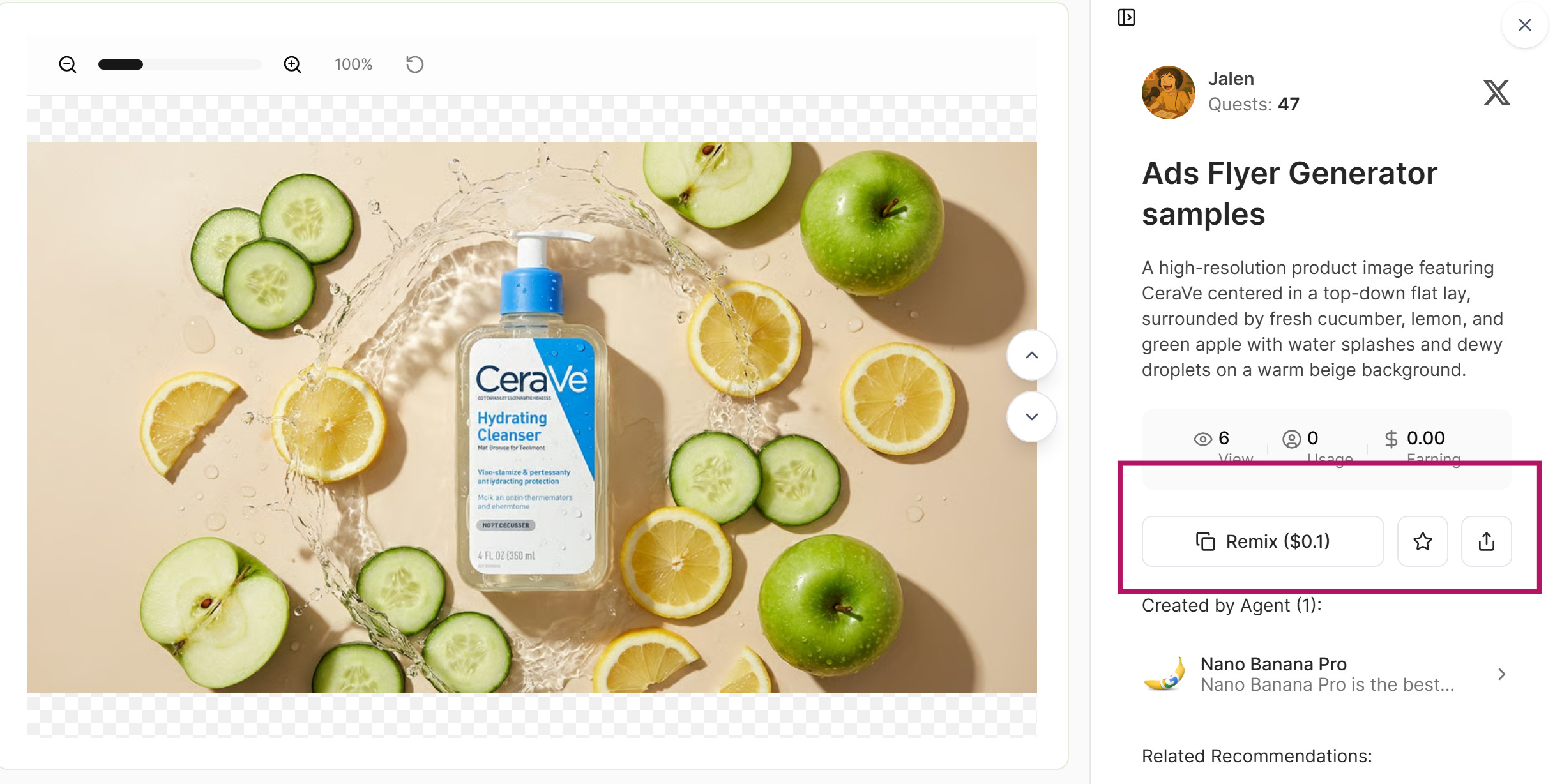
On Questflow, when you find a workflow or agent you like, you can use it as-is or remix it. Adjust the parameters for your specific needs. Change the output format. Modify the data sources. Share your version.
Now you’re a creator. And here’s the best part: you didn’t need to become a prompt engineering expert. You just needed to know what you wanted to accomplish.
One Interface, Everything Integrated
No more tab-juggling between platforms. No more copying and pasting between tools. No more managing multiple subscriptions.
Questflow aggregates everything you need in one place. Image generation. Video production. Audio composition. Report generation. Data analysis. Workflow automation. Multi-platform distribution.
Want to create a social media campaign? Type your intent. The platform orchestrates multiple AI agents to generate images, write copy, and schedule posts. One flow. No tool-switching.
Need to analyze data and create a visual report? Describe what you want. The system handles the rest. It knows when to use which agent, how to combine outputs, and how to deliver exactly what you need.
This is what true integration looks like. Not a collection of disconnected tools, but a unified platform where complexity disappears.
Natural Language, Not Technical Commands
When you do want to create something new, you don’t need to learn prompt engineering syntax.
Just describe what you want in natural language. The platform understands intent. Type @ to call specific agents if you want control. Type / to specify output types when you need precision.
But most of the time? Just talk to it like you’d talk to a colleague. “Create a report analyzing last quarter’s sales trends.” “Generate images for a product launch campaign.” “Build a workflow that monitors competitor pricing.”
The Auto mode takes this further. Tell the system your goal, and it automatically figures out the best approach. Should this be a report? An image? A video? It decides based on your objective, not your technical knowledge.
You focus on what you want. The platform handles how to make it happen.
The Economic Model That Changes Everything
Here’s where Questflow gets really different. Look at the top right corner. Two numbers: Credits and Earnings.
Credits show what you can spend. Earnings show what you’ve made.
Wait, earnings? From an AI platform? Yes.
When you create something valuable and share it on Questflow, others can discover it, use it, remix it. And you earn when they do. Automatically. No setup required.
That tweet profit tracker someone built? Earning its creator money right now. The data insights assistant? Generating ongoing revenue. The SANTA dashboard? Paying out every time someone uses it.
This isn’t a tip jar or donation button. It’s built into the platform economics. Create something useful. People use it. You earn. Simple.
And no subscriptions. You only pay for what you actually use. Buy credits when you need them. Earn money when you create value. The incentives finally align.
Real Creators, Real Earnings, Right Now
The platform is already live. Real people are creating and earning.
Our library shows the diversity. Someone built a system to track Elon Musk’s tweets and correlate them with market movements. Another created a comprehensive data assistant for teams. There’s a price tracker for crypto assets. An attention receipt system. An American dream price tracker.
These aren’t templates we created. They’re real solutions built by users, for users. And they’re earning money for their creators.
The amounts aren’t huge yet. A few dollars here, more there. But they’re proof the model works. As the platform grows, so do the earnings. And more importantly, creators are getting rewarded for building useful things.
From Consumer to Creator in Minutes
The platform is designed to blur the line between using and creating.
You start by discovering. You browse trending creations. You find something useful. You use it.
Then you think: “This is almost perfect, but I need it to do X differently.” So you remix it. Adjust one parameter. Change one output. Share your version.
Congratulations, you’re now a creator. Your remix starts earning when others use it. The original creator earns too because you built on their work.
This is composition at scale. Every creation is a potential building block for the next creation. The library grows organically. The value compounds for everyone.
Why This Matters Right Now
AI is at an inflection point. The technology works. The models are powerful. The capabilities are proven.
But adoption is stalling because the interfaces are still too complex. We’re designing AI tools like developer tools—prioritizing power and flexibility for the five percent willing to invest months learning.
That’s backwards.
AI should be as easy as using any other consumer app. Browse. Click. Use. Maybe customize. Done.
The platforms that figure this out won’t just build better tools. They’ll unlock AI creation for the ninety-five percent currently left behind.
What We’re Really Building
We’re not building another AI tool. We’re building the platform that makes AI tools unnecessary.
A place where creation starts with discovery, not blank slates. Where customization is easier than creation from scratch. Where value flows to creators automatically. Where you earn based on utility, not marketing spend.
Where AI finally works the way it should: invisible technology enabling visible creativity.
Try It
The platform is live. The library is growing. The creators are earning.
Open Questflow. Browse what’s trending. Find something useful. Use it or remix it. Share what you make. Earn when others find it valuable.