

There is a persistent misconception in crypto: that the primary challenge facing users is understanding markets.
In reality, most users never even get that far.
Before they can form a view, before they can act on a signal, before they can participate in any meaningful way, they encounter something far more immediate and far more frustrating — infrastructure.
Wallets need to be set up. Assets need to be bridged. Gas needs to be estimated and managed. Networks need to be selected correctly. Transactions fail for reasons that are often opaque, and retrying them requires even more context.
None of this has anything to do with trading.
And yet, it defines the experience.
Infrastructure Has Become the Bottleneck
Over the past few years, prediction markets and on-chain trading venues have made significant progress. Liquidity has improved, interfaces have become cleaner, and new categories of markets have emerged.
But the underlying interaction model has not fundamentally changed.
Participation still assumes that users:
Understand multiple blockchain environments
Hold the correct assets on the correct networks
Can manage transaction costs dynamically
Are comfortable navigating between disconnected systems
This assumption excludes more users than it enables.
Even for experienced participants, the process introduces friction at precisely the wrong moment — when speed and clarity matter most.
The result is not just inconvenience. It is lost participation, missed opportunities, and a system that remains narrower than it could be.
A Different Design Principle
At Questflow, we have been approaching this problem from a different angle.
Instead of optimizing each step in the process — making bridging slightly easier, or gas estimation slightly clearer — we asked a more fundamental question:
What if users did not need to interact with this layer at all?
What if the system could absorb the complexity, and present something much simpler in its place?
The Agent Wallet
The result is what we call the Agent Wallet.
It is not a new wallet in the conventional sense, nor is it a thin wrapper around existing infrastructure. It is an attempt to reframe how capital enters, moves within, and exits a trading system.
At a surface level, the functionality is straightforward. Users can deposit USDC from multiple chains, or fund their balance through fiat on-ramps integrated via Coinbase. Once deposited, those funds exist within a unified account inside Questflow.
What changes is everything that happens after that.
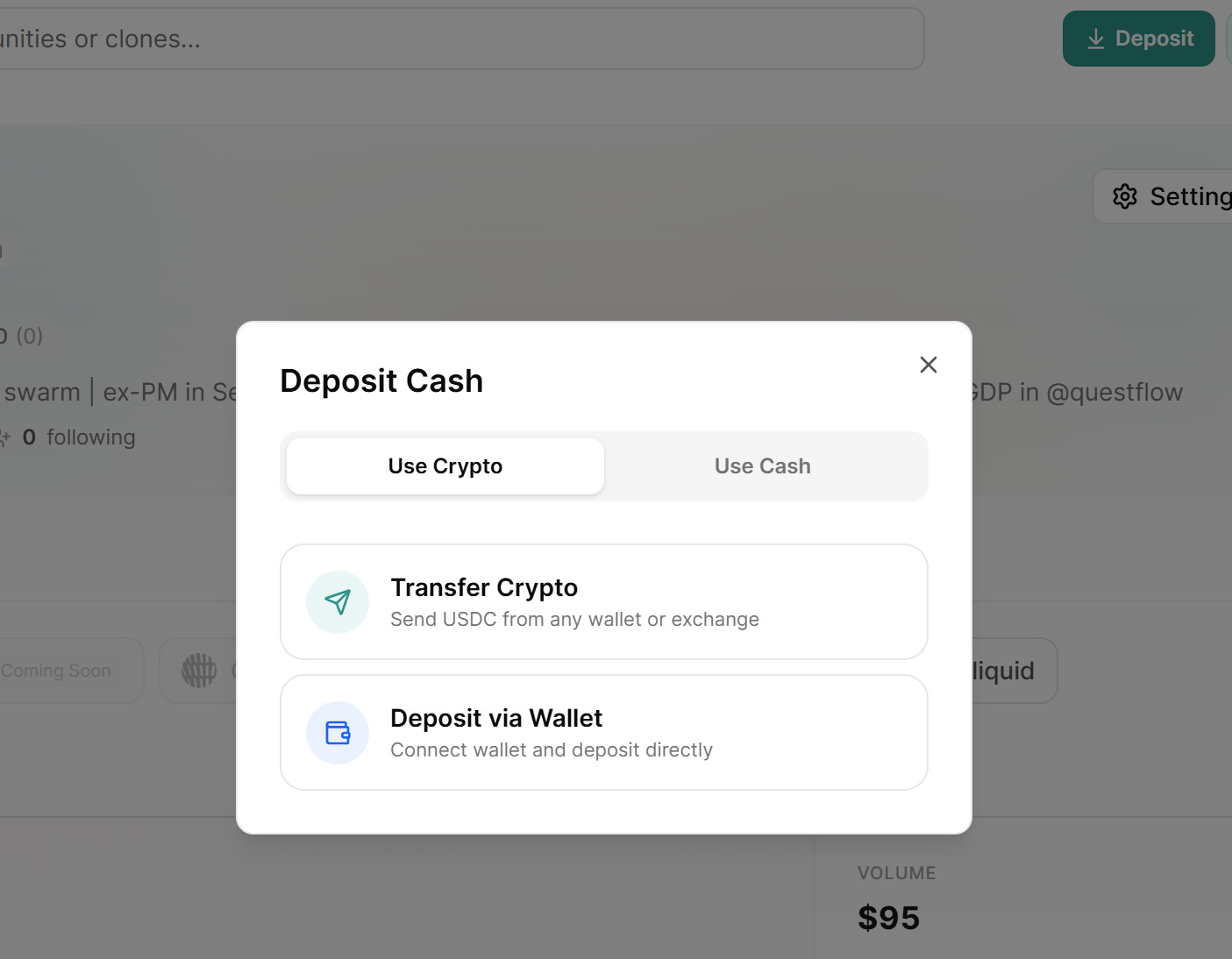
In a typical setup, moving funds from one environment to another requires explicit user action. Bridging assets, selecting networks, confirming gas fees, and waiting for settlement are all part of the flow.
With the Agent Wallet, those steps are removed from the user’s path.
Users do not need to manage gas. They do not need to hold native tokens. They do not need to decide how assets move between internal and external systems.
They simply allocate capital.
A Unified Execution Layer
One of the less obvious consequences of multi-chain ecosystems is fragmentation — not just of liquidity, but of attention.
When assets are distributed across networks, users are forced to think in terms of infrastructure rather than intent. A decision to act becomes entangled with questions about where funds are located and how they can be moved.
The Agent Wallet collapses this distinction.
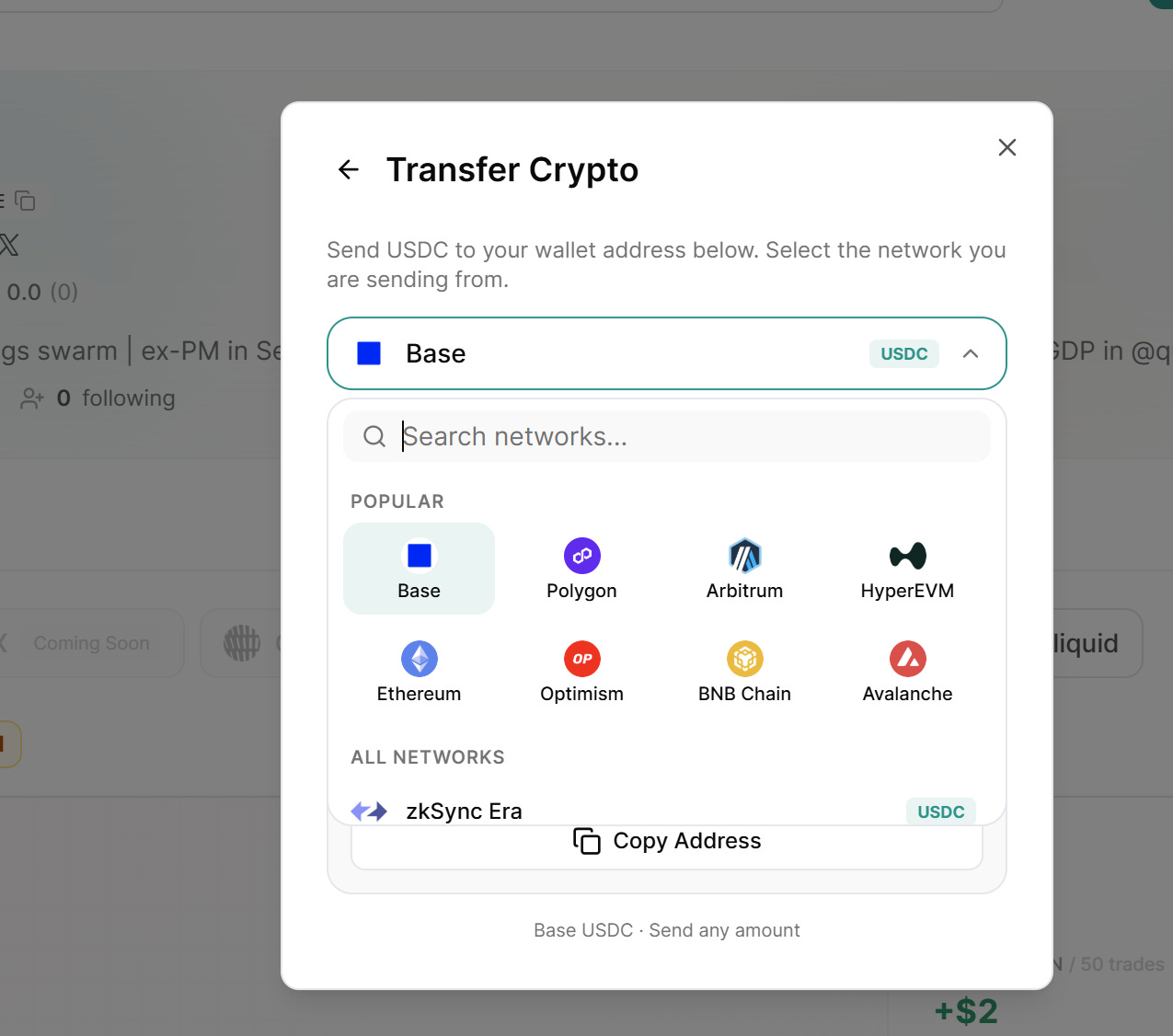
Users can send USDC from a range of supported networks — Base, Polygon, Arbitrum, Ethereum, and others — into a single balance. From that point onward, the origin of the funds becomes irrelevant.
What matters is not where the capital came from, but what it can be used for.
Removing Gas from the User Experience
Perhaps the most visible change is the removal of gas from user-facing interactions.
Gas, in principle, is a necessary component of decentralized systems. In practice, it has become one of the largest sources of friction.
It introduces variability, requires additional assets, and creates failure modes that are difficult to predict.
The Agent Wallet abstracts this away.
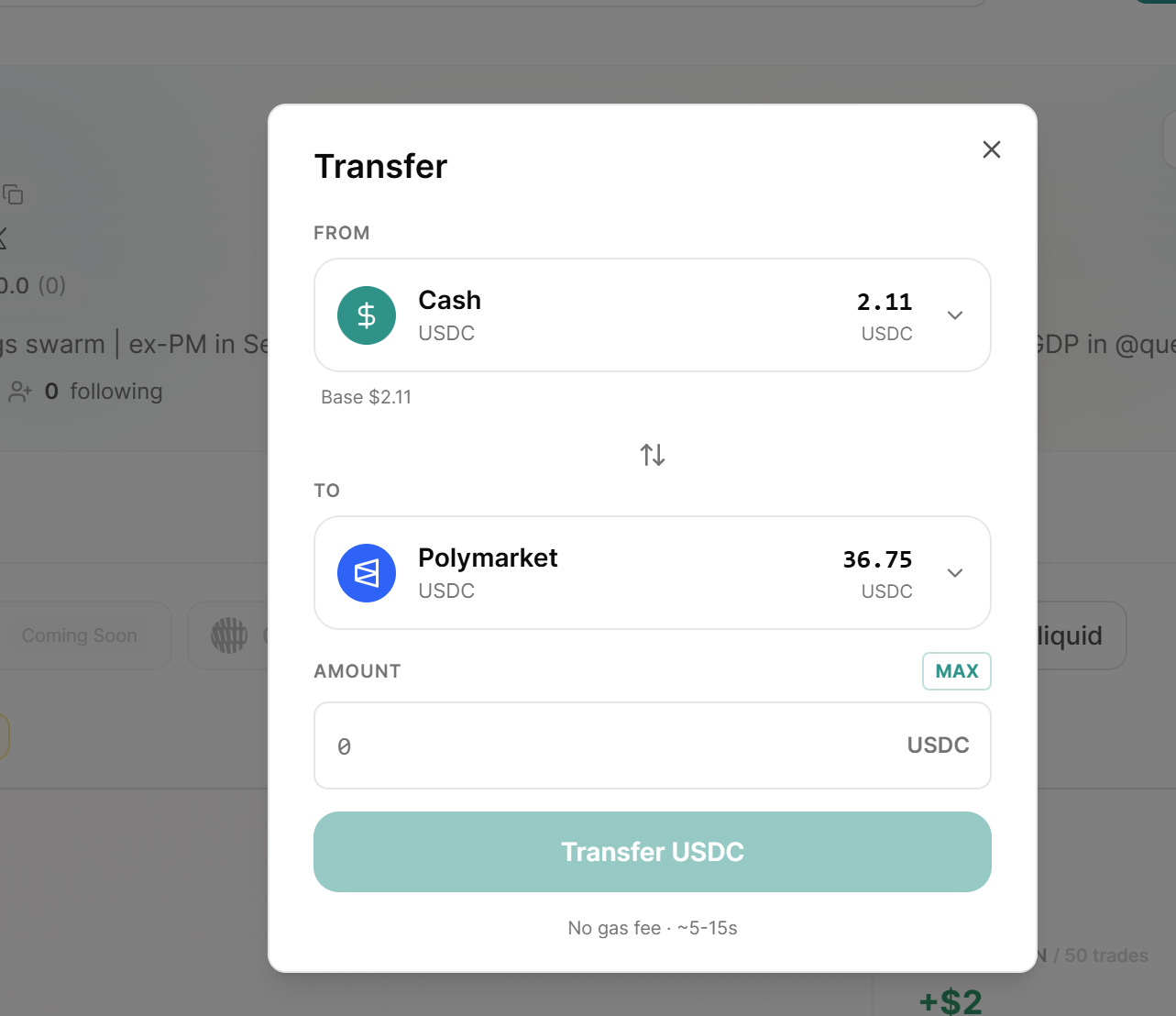
Transfers within the Questflow system, as well as interactions with supported external venues, are handled without requiring users to manage or even think about gas.
This does not eliminate the underlying cost. It relocates it — from the user’s cognitive burden to the system’s design responsibility.
Bridging Without Bridges
Another consequence of abstraction is that explicit bridging disappears.
Users no longer need to decide whether to bridge assets, how to do it, or when it is worth the cost. The system handles movement across environments as part of its internal logic.
This is a subtle shift, but an important one.
Bridging is not a user intention. It is an implementation detail. Treating it as a first-class user action has always been a compromise.
The Agent Wallet removes that compromise.
Direct Access to Markets
The practical outcome of this design is a more direct connection between capital and opportunity.
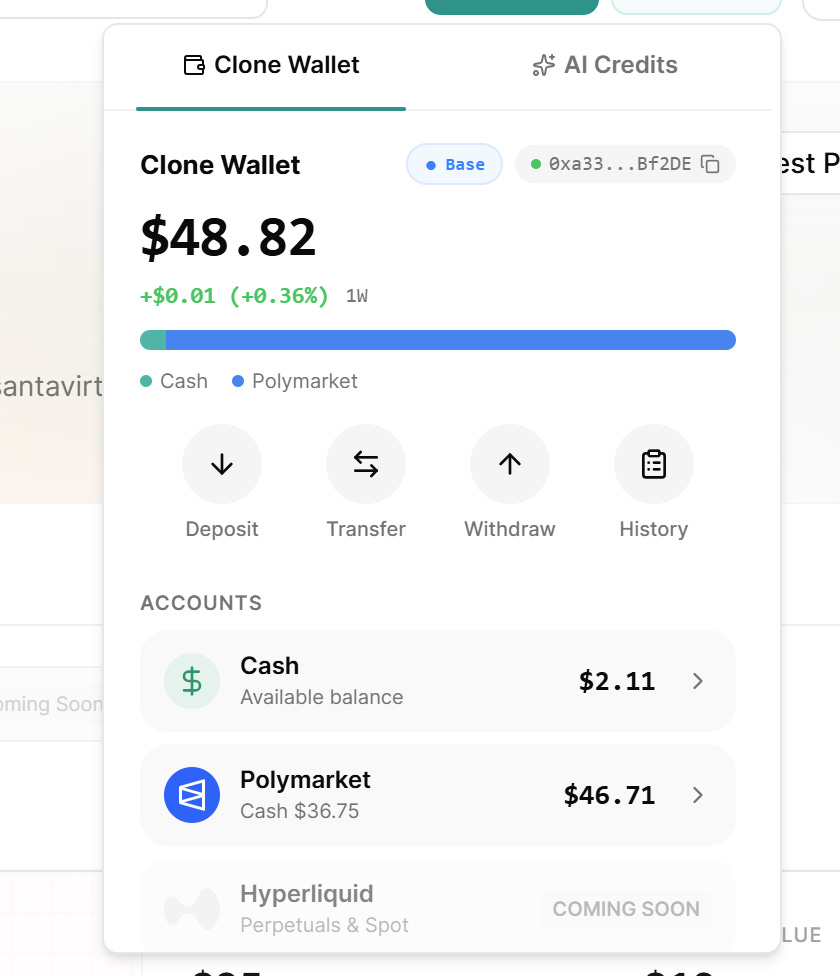
From a single balance, users can allocate funds to external systems such as Polymarket or Hyperliquid, without leaving the Questflow environment or repeating onboarding steps.
This effectively creates a unified execution layer across multiple venues.
Instead of navigating between platforms, users operate from a single point of control.
Fiat as a First-Class Entry Point
For many users, the initial barrier is not movement between chains, but entry into the system itself.
Integrating fiat on-ramps through Coinbase allows users to move from traditional payment methods directly into USDC balances within the Agent Wallet.
This closes a loop that has historically been fragmented.
The path from fiat to participation becomes linear, rather than multi-step and error-prone.
Why This Matters
The significance of the Agent Wallet is not in any individual feature, but in the removal of an entire category of decisions.
Users no longer need to think about:
Which chain to use
How to fund gas
When to bridge
How to move assets between systems
These are not high-value decisions. They are operational overhead.
By removing them, the system shifts user attention back to what actually matters: evaluating opportunities and making informed decisions.
Toward Invisible Infrastructure
If crypto is to reach a broader audience, its infrastructure cannot remain user-facing.
The current model assumes a level of technical fluency that does not scale. Simplifying interfaces is not sufficient if the underlying mental model remains complex.
What is needed is abstraction.
Not the removal of functionality, but the removal of unnecessary exposure to it.
The Agent Wallet is one step in that direction.
Integrated Into a Larger System
Within Questflow, this wallet is not an isolated component. It underpins a broader effort to connect intelligence and execution.
As users discover opportunities through AI-assisted systems, evaluate them through shared insights, and act on them across markets, the Agent Wallet ensures that capital can move as seamlessly as information.
Without this layer, the system remains incomplete.
With it, the loop between insight and action begins to close.
Opening Access
The Agent Wallet is now available within Questflow, and we are gradually expanding access as we continue to refine the system.
As with any infrastructure change, real-world usage is the most important source of feedback.
We are particularly interested in how users:
Move capital across different contexts
Interact with external venues
Experience the removal of gas and bridging from their workflows
Early Participation
We are also introducing incentives for early users who actively engage with the system.
This includes rewards for:
Testing and providing feedback
Participating in trading activity
Contributing to the growth of the network
As the system evolves, there will be additional mechanisms for sharing value with users who contribute meaningfully — whether through activity, insight, or bringing others into the ecosystem.
Conclusion
The history of trading systems is, in many ways, a history of abstraction.
From physical exchanges to electronic markets, from manual execution to algorithmic strategies, each step has removed layers of friction between intention and action.
Crypto has introduced new capabilities, but also new forms of complexity.
The next phase is not about adding more features.
It is about making those capabilities accessible without requiring users to understand their underlying mechanics.
The Agent Wallet is a small but necessary step in that direction.